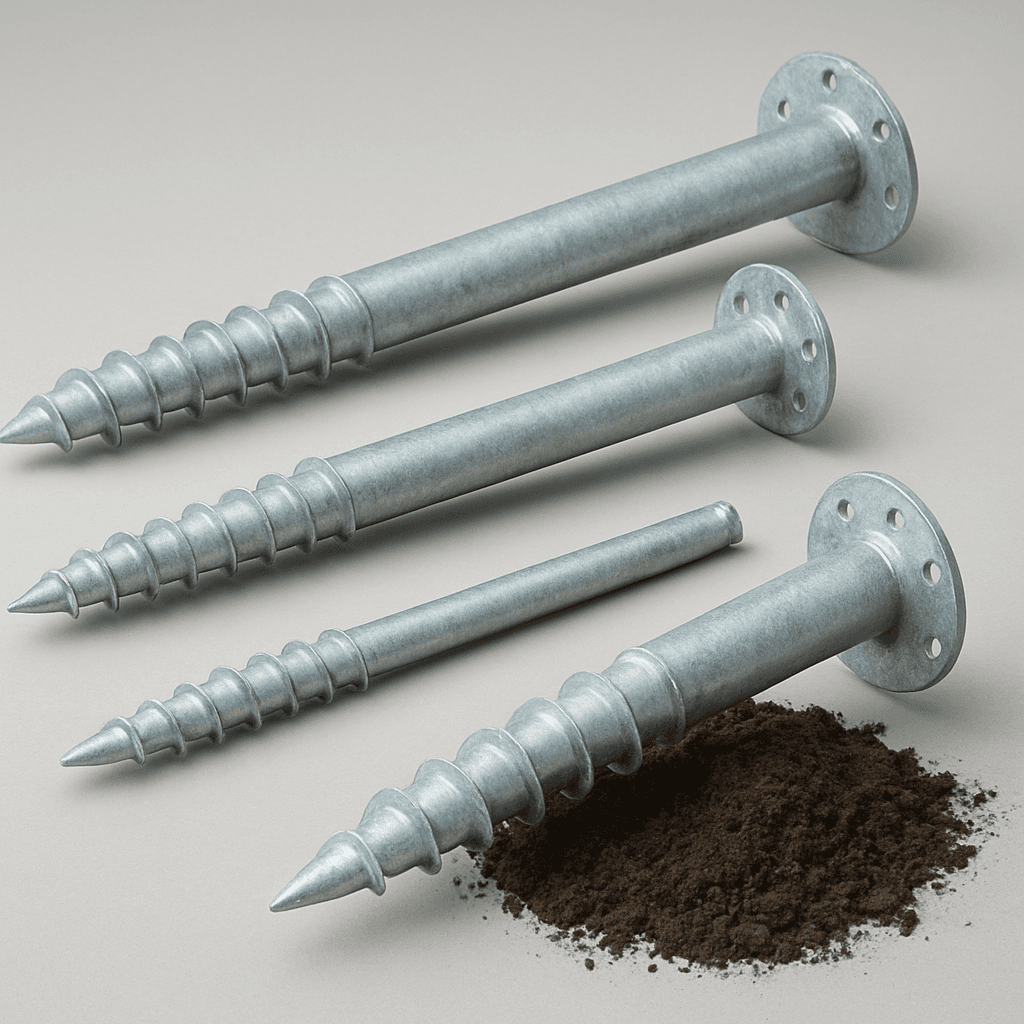
Ground Screw vs. Driven Pile Solar Foundations: How to Choose
Choosing the right foundation for your ground-mount solar project feels like a massive decision with long-term consequences. You worry that if you pick wrong, you could be facing unexpected budget overruns, frustrating installation delays, or even long-term structural issues. This guide is here to clarify the Ground Screw vs. Driven Pile debate, helping you select the right solar foundations based on your specific site conditions and project goals.
The best choice between ground screws and driven piles for your solar foundations depends entirely on a project-specific trade-off analysis. Driven piles are often chosen for large, uniform sites with favorable soil, offering lower material costs. Ground screws, however, excel in complex terrain, on sites with restricted access, or where minimal soil disturbance and faster installation are critical, even with a higher per-unit cost. The final decision must always be guided by a professional geotechnical report.
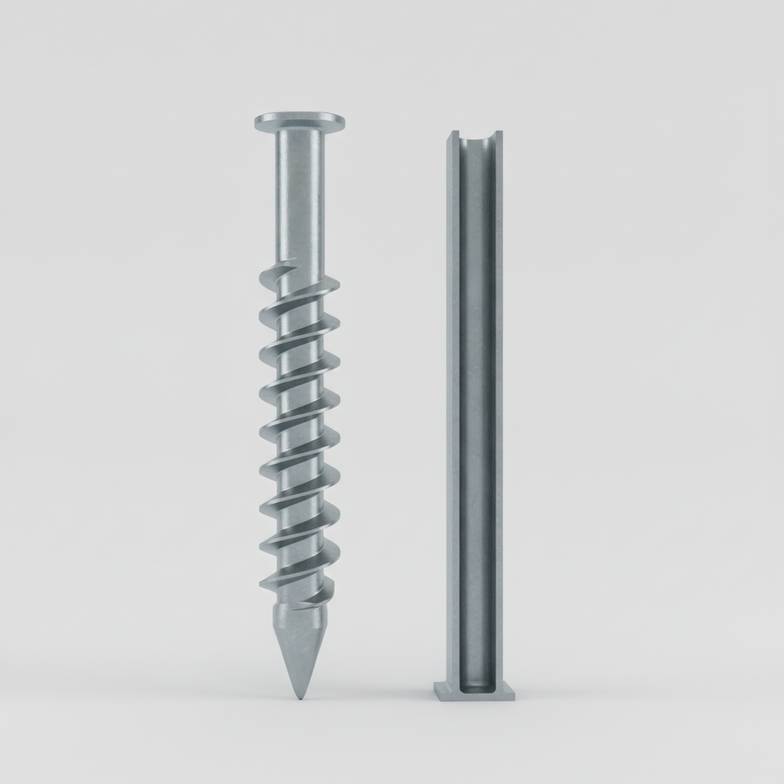
As you can see, there's no single "winner" here. The right answer is about what's best for your project. To make an informed decision, we need to dig into the key variables that truly drive the outcome: the ground beneath your feet, your project's logistics, and the total installed cost.
How Do Soil Conditions Affect the Ground Screw vs. Driven Pile Decision?
Are you worried that unknown soil issues could derail your project timeline and budget? Hitting unexpected rock or soft clay can turn a straightforward installation into a logistical nightmare. Understanding how each of these solar foundations interacts with the ground is your first line of defense against costly surprises.
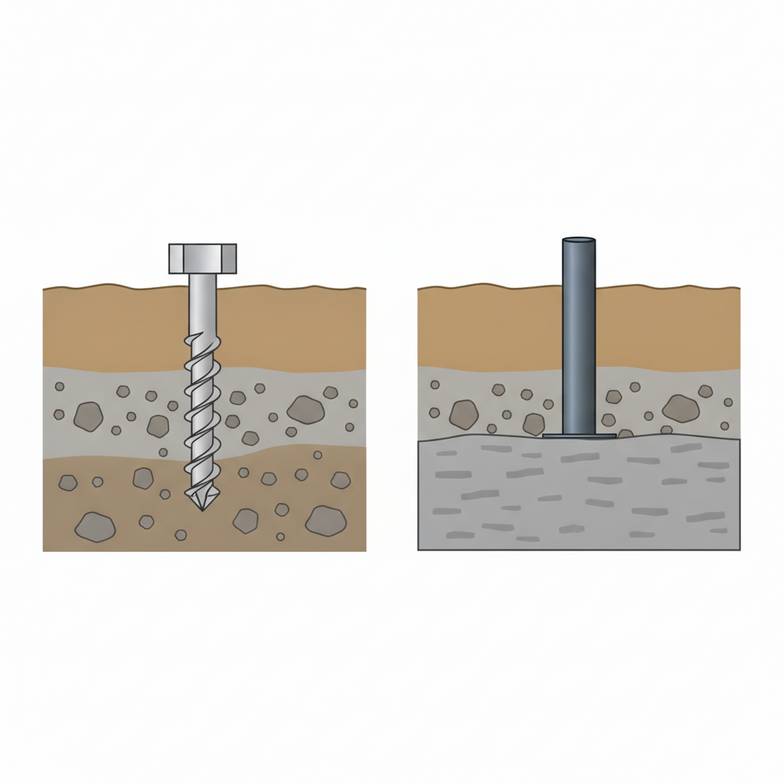
Rocky, mixed, or sloped terrain often favors ground screws, which can be precisely installed and can drill through many challenging substrates. Driven piles perform best in consistent, dense soils but can meet refusal in rock, requiring expensive pre-drilling. Soft or loose soils might require longer piles or specially designed screws for adequate uplift resistance.
The Geotechnical Report Is Your Project's Blueprint
Before any supplier can give you a reliable recommendation, you need a geotechnical report. I can't stress this enough. In my experience, any foundation plan made without one is just a guess. This report is created by a geotechnical engineer who takes soil borings at your site. It tells you everything you need to know:
Soil Layers: The type and depth of different soils (clay, sand, gravel, loam).
Obstructions: The presence of bedrock, boulders, or a high water table.
Load-Bearing Capacity: How much weight the soil can safely support.
Corrosivity: Whether the soil has properties that could degrade the steel foundations over time.
This document is the single most important piece of information for deciding on your solar foundations. A good supplier won't just ask for it; they will use it to justify their recommendation.
Navigating Different Ground Conditions
With a geotechnical report in hand, you can start to analyze the trade-offs.
Rocky or Cobbled Ground This is where driven piles often run into trouble. A pile driver hammers the post into the ground. If it hits a large boulder or solid bedrock, it's called "refusal." The pile simply can't go any deeper. Your options are to either pull the pile and try another spot (which may not be possible with a fixed layout) or bring in more equipment to pre-drill a hole, which adds significant time and cost.
Ground screws, on the other hand, are screwed into the ground. They behave more like a drill bit and can often chew through fractured rock and displace smaller cobbles. For sites with known rock issues, ground screws can prevent major headaches.
Soft Clays and Loose Sands In these conditions, the challenge isn't refusal—it's pull-out strength (uplift resistance). Wind getting under the solar panels can create a powerful lifting force.
Driven Piles: To get enough grip in soft soil, piles may need to be driven much deeper to reach a more stable soil layer, increasing material costs and installation time.
Ground Screws: For soft soils, you can use screws with wider helical plates. This larger surface area provides excellent resistance against uplift forces, often without needing to go as deep as a driven pile.
Sloped or Undulating Terrain Ground screws have a clear advantage on uneven sites. The installation equipment—typically an excavator or skid steer—is highly maneuverable and can easily adjust to different angles. This allows for precise placement of each foundation post, even on a steep grade. Setting up a large, heavy pile-driving machine on a slope is far more complex and time-consuming.
What Are the Installation & Equipment Differences Between Ground Screws and Driven Piles?
Your project site might be tight on space, or maybe your schedule is unforgiving. You're concerned that your foundation choice will lock you into using heavy, disruptive, and slow equipment that could cause problems for the site or the surrounding area.
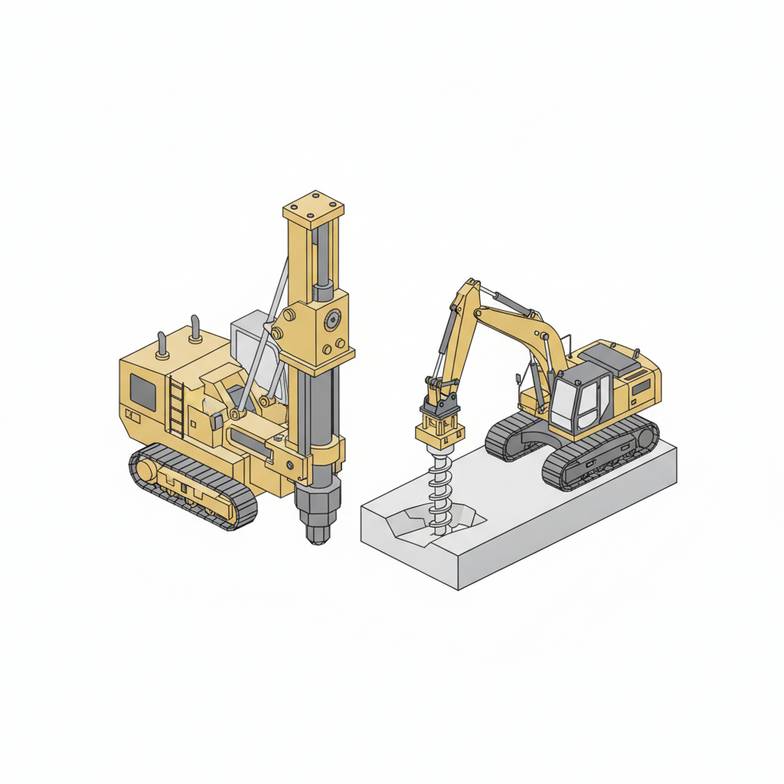
Driven piles require heavy-duty hydraulic hammers or vibratory drivers, which are usually mounted on large, tracked machines. Ground screws are installed with smaller, more agile hydraulic rotary drives, often attached to standard excavators or even large skid steers, resulting in far less ground disturbance and noise.
The Heavy Hitters: Pile Driving Equipment
When you choose driven piles, you're also choosing the equipment that comes with them. These are specialized machines, like GAYK or Vermeer pile drivers, that are heavy and powerful.
Site Access: They need wide access paths, clear of obstacles, and a relatively flat, stable area to operate. If your site is small, has tight corners, or is covered in mature trees you want to preserve, getting this machine in and out can be a major challenge.
Noise and Vibration: Pile driving is loud. Very loud. It also creates significant ground vibration. This can be a deal-breaker for projects near residential areas, sensitive businesses (like hospitals or labs), or fragile existing infrastructure. I've heard from installers who had to limit their work hours due to noise complaints, which stretched out the project timeline.
The Agile Alternative: Ground Screw Installation
Ground screw installation uses equipment that is probably already on your construction site. A hydraulic rotary drive (from brands like Digga or Auger Torque) can be quickly attached to a standard excavator.
Flexibility: An excavator can navigate tight spaces, reach over obstacles, and work on uneven ground with ease. This opens up possibilities for sites that would be inaccessible to a large pile driver.
Low Impact: The process is quiet and virtually vibration-free. You're simply screwing the foundation into the ground. This makes it an ideal solution for environmentally sensitive areas, urban projects, and sites where you need to keep disruptions to a minimum. Because there's no major soil displacement, you also avoid the cost of hauling away excavated dirt.
Comparing Installation Logistics
The best way to see the difference is to compare them side-by-side.
Feature: Primary Equipment | Driven Piles: Specialized heavy-duty pile driver | Ground Screws: Standard excavator with hydraulic rotary attachment
Feature: Site Access Needs | Driven Piles: Wide, clear paths; relatively flat ground | Ground Screws: Highly flexible; can access tight and uneven areas
Feature: Ground Disturbance | Driven Piles: Significant soil displacement and compaction | Ground Screws: Minimal soil displacement; preserves the landscape
Feature: Noise & Vibration | Driven Piles: High noise levels and strong ground vibrations | Ground Screws: Low noise levels and virtually no vibration
Feature: Weather Dependency | Driven Piles: Can be difficult in very wet or frozen conditions | Ground Screws: Can often be installed year-round, even in frost
Feature: Cleanup | Driven Piles: May require site grading and removal of spoils | Ground Screws: Minimal cleanup; no excavated soil to manage
Ultimately, your choice here directly impacts your project management. The Ground Screw vs. Driven Pile decision is as much about logistics and risk management as it is about engineering.
How Does the Cost of Ground Screws vs. Driven Piles Break Down?
You're trying to build a reliable budget, but suppliers are giving you conflicting information on foundation costs. It's incredibly frustrating when you can't get a clear picture of the total project expense, moving beyond just the per-unit price tag.
Driven piles typically have a lower per-unit material cost, which can look attractive on a quote. However, the total installed cost can quickly increase due to expensive equipment rental, the need for extensive site preparation, and potential soil remediation. Ground screws have a higher material cost but can often save money on labor, equipment, and timeline, resulting in a lower total installed cost, especially on complex sites.
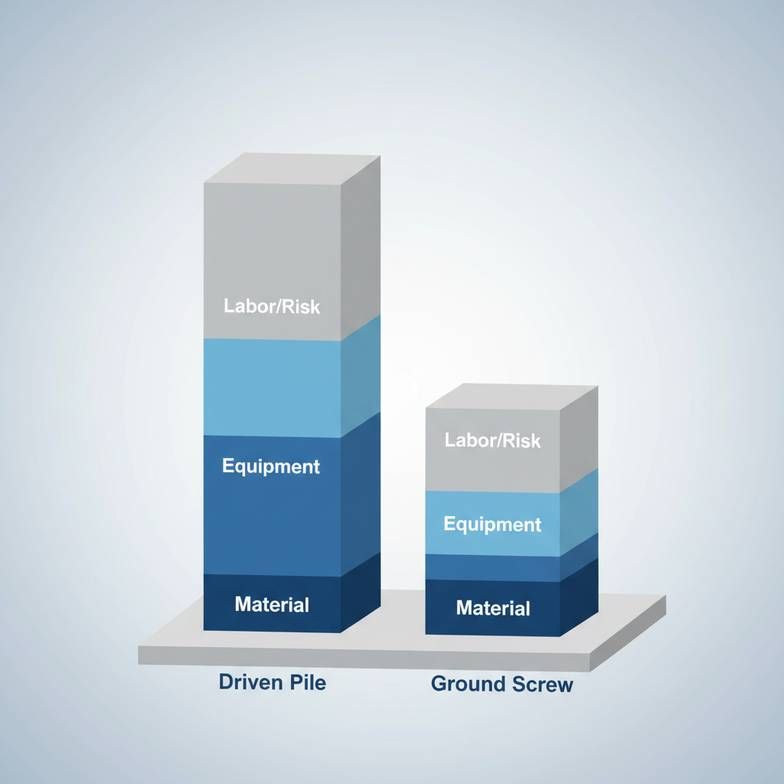
The Real Story: Total Installed Cost
When I talk to procurement managers, I always advise them to look past the material price per piece. The true cost of your solar foundations is the sum of all its parts. You must analyze the complete picture to avoid surprises.
Cost Components for Driven Piles
Material Cost: Generally lower. A simple C-channel or I-beam pile is less complex to manufacture than a ground screw.
Geotechnical Investigation: Absolutely essential and can be expensive, especially if the report recommends on-site pile load tests.
Equipment Mobilization: This is a huge hidden cost. Renting and transporting a specialized pile driver to your site can cost thousands of dollars before the first pile is even touched.
Labor: Requires a specialized, experienced crew to operate the heavy machinery safely and efficiently.
Contingency Costs: This is the big risk factor. If you hit refusal, the costs for pre-drilling, project delays, and extra labor can explode. I've spoken with project managers who chose piles to save 15% on materials, only to spend 40% more than their total foundation budget on dealing with unexpected rock.
Cost Components for Ground Screws
Material Cost: Higher. The helical plate and tapered tip require more steel and a more involved manufacturing process.
Geotechnical Investigation: Still required, but on-site pull-out tests to verify capacity can often be done quickly with the same equipment used for installation.
Equipment Rental: Much lower. You're likely already using an excavator for other site work. The rotary drive attachment is a far less expensive rental than a dedicated pile driver.
Labor: Installation is fast and can often be handled by a smaller, less specialized crew, reducing labor costs.
Contingency Costs: Significantly lower. Because the equipment is more agile and the foundation is more adaptable to varied soil, the risk of a major show-stopping issue is reduced. If you hit an impassable obstacle, shifting a few inches is often a simple fix.
The lesson is clear: don't let a low material quote blind you. A thorough Ground Screw vs. Driven Pile cost analysis must include every factor from mobilization to potential remediation.
Frequently Asked Questions
Can ground screws be used in all soil types?
Ground screws are incredibly versatile and work well in many soil types, including clay, sand, gravel, and even soft rock. However, for very soft, organic clays or highly corrosive soils, a geotechnical engineer must verify their suitability and may specify a certain coating or length. They are not suitable for solid bedrock.
Are driven piles removable?
Yes, driven piles can be extracted using a vibratory hammer in reverse, but the process requires the same heavy equipment used for installation. It causes significant ground disturbance and leaves a large void that needs to be backfilled. Ground screws, by contrast, are easily unscrewed and removed, leaving almost no trace.
How does frost heave affect these solar foundations?
Both foundation types must be installed so their load-bearing section is below the local frost line to prevent movement. Driven piles rely on skin friction along their length to resist heave. The helical plate on a ground screw provides excellent, direct resistance to uplift forces from frost, making it a very reliable solution in cold climates.
Which foundation is better for the environment?
Ground screws are generally considered the more environmentally friendly option. Their installation is vibration-free and displaces very little soil, protecting the local ecosystem. They don't require concrete, and because they are easily removed, the site can be returned to its natural state at the end of the project's life. They are also often reusable.
Conclusion
In the end, the Ground Screw vs. Driven Pile decision is not about finding a default winner. It is a strategic choice based on a detailed analysis of your geotechnical report, site logistics, project timeline, and total installed budget. Driven piles remain a powerful and cost-effective solution for large-scale solar farms on open, uniform ground. However, ground screws offer unmatched flexibility, speed, and low impact, making them an increasingly popular choice for projects with challenging soil, tight access, or environmental sensitivities. To make the best choice for your solar foundations, you must empower yourself to look beyond the material quote and weigh all the real-world trade-offs.
Ready to find the optimal foundation and mounting solution for your solar project? Submit your project details—including the site location, geotechnical report, array layout, and module specifications—and our team can help you evaluate your options and prepare a comprehensive quotation.
Written by
XINVOK Technical Team
Practical solar mounting knowledge for EPC teams, distributors and project buyers.
Project inquiry
Talk to Our Team
Share your project location, module size, mounting type, quantity and customization requirements.